Loading…

- Sign In
JOIN AS USER
Get evaluation checklists and much more!
Join as userJOIN AS PROVIDER
Join now to get leads without referral fees!
Join as providerSIGN IN
Welcome back!
Sign In
Loading…
 Guide
Essential tips and questions for evaluating any senior living community.
Choosing an Assisted Living community or Nursing Home is an important decision. A community may look impressive online or during a short tour, but understanding what everyday life will actually be like requires a more systematic evaluation.
This guide explains what care seekers should look for, ask about, and verify when evaluating a community. It covers the living environment, rooms, food, staff, care, activities, safety, pricing, policies, quality information, and other factors that can affect a resident's experience.
The guide can be used on its own or together with the Map of Care Assisted Living and Nursing Homes evaluation tools, which are designed to help care seekers evaluate communities after a physical visit or virtual tour and compare their results.
The right Assisted Living community or Nursing Home is different for every person. The most suitable choice depends on the resident's care needs, health and mobility, preferences, finances, location, and expectations for daily life.
For that reason, choosing a community should involve more than comparing prices or looking at photographs. A visit gives care seekers an opportunity to observe the environment, see how residents and staff interact, ask detailed questions, and determine whether the community appears capable of meeting the person's needs.
A useful way to approach the evaluation is:
Observe. Look carefully at the environment and how the community operates.
Ask. Ask specific questions about care, staffing, services, costs, policies, and daily life.
Verify. Confirm important information through written documents, licensing records, Medicare information, and other reliable sources.
Map of Care's Assisted Living and Nursing Homes evaluation tools use a similar visit-and-evaluate approach. The tools are intended to be used after visiting a community, either physically or through a virtual tour, and can help care seekers compare communities systematically.
Important: No single rating, checklist, tour, or first impression should determine the decision. The goal is to gather enough information to decide which community best matches the prospective resident's needs and preferences.
Good preparation makes a visit more useful. Before touring a community, research the basic information available and identify the issues that matter most to the prospective resident.
Review:
• Location and surrounding area.
• Type of community and care provided.
• Licensing or certification.
• Available services.
• Room types.
• Pricing and additional fees.
• Payment options.
• Quality and inspection information, where available.
• Reviews and experiences reported by residents and families.
For Nursing Homes, Medicare provides information about areas such as health inspections, staffing, and quality measures. For California Assisted Living communities, licensing information is available through the California Department of Social Services.
Make a list of the person's current needs and priorities. These may include:
• Assistance with bathing, dressing, or toileting.
• Mobility or transfer assistance.
• Medication management.
• Assistance with eating.
• Incontinence care.
• Memory or cognitive support.
• Therapy or rehabilitation.
• Special dietary needs.
• Transportation.
• Access to healthcare.
• Social, recreational, or spiritual interests.
This helps you evaluate the community against the person's actual situation rather than simply deciding whether you like the building.
Bring a written list and take notes during or immediately after the visit. If you are comparing several communities, use the same core criteria for each one.
Map of Care offers General Tools specifically for Assisted Living communities and Nursing Homes. The digital tools provide an overall evaluation, while registered users can also access downloadable evaluation checklists for use during a visit.
The important point is that the tools are not a substitute for visiting. They are designed to help organize what you observe and learn during the evaluation.
You can explore the Assisted Living evaluation tool or the Nursing Homes evaluation tool. The downloadable checklists are available after signing up for free.
Tip: Evaluate each community soon after or even during visiting it. This makes it easier to remember specific observations and avoid mixing details from different communities.
Location affects both the resident's daily experience and the family's ability to remain involved.
Consider:
• Distance from family and close friends.
• Driving time and traffic.
• Public transportation.
• Nearby hospitals and healthcare providers.
• Pharmacies and grocery stores.
• Restaurants, cafés, parks, and other amenities.
• Walkability.
• Noise and traffic.
• General character of the neighborhood.
A community that is slightly farther away may still be a better choice if family members can reach it easily and visit regularly.
During the visit, take a moment to look at the surrounding neighborhood.
Ask yourself:
• Is the area pleasant and comfortable?
• Is the property easy to enter and leave?
• Is parking convenient?
• Can residents safely spend time outdoors?
• Are there nearby places the resident would enjoy visiting?
• What transportation does the community provide?
• Is transportation included in the price?
• Where can residents go using community transportation?
• How are medical appointments handled?
• Which hospitals and pharmacies are commonly used?
• Can family members easily take residents out and return them?
Tip: Consider the actual travel time from the homes of the people who will visit regularly, rather than relying only on distance shown on a map.
The first few minutes can provide useful clues, but the entrance should not be the basis for the entire decision.
Pay attention to:
• Cleanliness.
• Persistent odors.
• Lighting.
• Noise levels.
• Temperature.
• Maintenance.
• General atmosphere.
• Whether residents appear comfortable.
• Whether residents are spending time outside their rooms.
• How staff interact with residents.
Watch what happens outside the formal presentation. An attractive lobby is less important than the environment where residents actually spend their time.
Look for respectful and patient communication. Do staff appear attentive? Do they know residents by name? Do residents seem comfortable asking for assistance?
One interaction cannot tell you everything, so look for patterns.
• Who should families contact with concerns?
• How are complaints handled?
• Are visitors welcome throughout the day?
• Are there visiting restrictions?
• What security measures are in place?
• How are families informed when a resident's condition changes?
Important: A pleasant atmosphere is valuable, but it should be considered alongside care, staffing, safety, pricing, licensing, and the community's ability to meet the resident's needs.

The resident's room is their personal living space, so privacy, comfort, accessibility, and storage can matter as much as appearance.
Consider:
• Room size and layout.
• Private versus shared accommodation.
• Natural light.
• Storage and closet space.
• Bathroom access.
• Accessibility for walkers or wheelchairs.
• Space for personal belongings.
• Temperature controls.
• Internet and telephone availability.
• Emergency call systems.
• Noise.
• Privacy.
When possible, ask to see a representative room rather than evaluating only a staged model room.
Ask:
• Can residents bring their own furniture?
• Can they personalize the room?
• What room types are available?
• Are private bathrooms available?
• What happens if a resident wants to change rooms?
Consider whether the room can accommodate the person's medical and mobility needs.
Ask:
• Is there enough space for mobility equipment?
• How is privacy maintained during personal care?
• What furnishings are provided?
• What happens if the resident's needs increase?
• What happens if a resident requests a different room or roommate?
• What furniture is included?
• What can the resident bring from home?
• Is there an additional charge for a private room?
• What services are included in the room rate?
• Are there additional charges for telephone, television, or internet?
Tip: Spend a few minutes sitting in the room. Consider whether it feels comfortable, private, bright enough, and reasonably quiet.
Bathrooms and other physical features should be evaluated according to the resident's current abilities and likely future needs.
Check for:
• Accessible showers.
• Grab bars where appropriate.
• Adequate space for walkers or wheelchairs.
• Slip-resistant flooring.
• Good lighting.
• Accessible toilets and sinks.
• Handrails.
• Accessible elevators.
• Easy-to-use doors and fixtures.
• Emergency call systems where appropriate.
Ask:
• Can the resident safely reach and use the bathroom?
• Is there enough space for a caregiver to assist?
• Are there stairs or other barriers?
• Could the environment accommodate increasing mobility limitations?
A community that works well today may not remain suitable if the person's mobility or care needs change.
Ask how the community handles:
• Falls.
• Medical emergencies.
• Fires and evacuation.
• Power outages.
• Residents at risk of wandering.
• Emergency transportation.
• Communication with family members.
For Nursing Homes, also ask how hospital transfers are handled and how families are informed.
Tip: Evaluate accessibility not only for the resident's current abilities, but also for likely changes in mobility or care needs.
Common areas can provide useful insight into the resident experience. Look beyond whether the spaces are attractive and consider how residents actually use them.
Visit, where possible:
• Lounges.
• Living rooms.
• Activity rooms.
• Libraries.
• Dining areas.
• Exercise spaces.
• Outdoor areas.
Consider:
• Cleanliness.
• Lighting.
• Temperature.
• Noise.
• Furniture.
• Accessibility.
• Maintenance.
• Variety of spaces.
Ask yourself:
• Are residents spending time outside their rooms?
• Are they interacting with one another?
• Are staff present and engaged?
• Are activities taking place?
• Are there both quiet and social spaces?
• Do residents appear to have choices about where they spend their time?
A beautifully designed lounge is less meaningful if residents rarely use it.
Look for spaces that support different interests and abilities, such as quiet areas, social spaces, outdoor areas, activity rooms, and places where families can spend time with residents.
Consider whether common areas are comfortable and accessible for residents with greater physical or cognitive needs.
Ask whether:
• Wheelchairs can move easily through the spaces.
• Residents who need assistance can participate comfortably.
• Quieter areas are available when needed.
• Families can spend private time with residents.
Tip: Observe ordinary moments when there is no formal tour or presentation. These can reveal more about daily life than the community's promotional materials.

The people who provide care and interact with residents every day are among the most important factors to evaluate. A community may have attractive rooms and excellent amenities, but residents' experiences depend heavily on the quality, availability, and consistency of its staff.
During the visit, observe how staff interact with residents.
Look for:
• Respectful and patient communication.
• Staff who know residents by name.
• Residents receiving assistance when they need it.
• Staff who appear attentive rather than consistently rushed.
• Staff interacting with residents during meals and activities.
• Familiarity between residents and the people caring for them.
A single interaction does not tell you everything. Try to observe staff in different areas of the community and during ordinary activities.
Ask:
• How many caregivers or nursing staff are normally present on each shift?
• Does staffing change during evenings, nights, weekends, or holidays?
• Are licensed nurses available around the clock?
• How does staffing change when residents' needs increase?
• How much temporary or agency staff is used?
• How long do staff typically remain with the community?
• What training do caregivers receive?
For Nursing Homes, Medicare provides staffing information that can be used as one part of the comparison process.
Tip: Don't focus only on the number of employees. Ask whether staffing is sufficient to meet residents' needs and observe whether staff appear to have enough time to care for and interact with residents.

A community should be evaluated against the specific care needs of the prospective resident, both now and as those needs may change.
Depending on the community, personal assistance may include:
• Bathing.
• Dressing.
• Grooming.
• Toileting.
• Eating.
• Mobility and transfers.
• Incontinence care.
• Medication assistance or management.
Ask:
• How is a resident's care level assessed?
• How often is it reassessed?
• Which services are included in the basic price?
• Which services cost extra?
• What happens when a resident needs more assistance?
• At what point would the community be unable to meet the resident's needs?
For a Nursing Home, consider whether the community can meet the person's specific nursing and personal-care needs, including mobility, continence, medication administration, feeding assistance, cognitive impairment, medical equipment, or rehabilitation needs.
Medicare explains that Nursing Home assessments and care plans identify the services a resident needs, who will provide them, how often they are needed, equipment and supplies, dietary requirements, and care goals.
Ask the community to explain specifically:
• What services are provided?
• Who provides them?
• How frequently are they provided?
• How are changes in care needs handled?
• How are families informed about significant changes?
Important: Don't ask only whether a community "provides care." Determine whether it can provide the specific type and level of care the resident needs.
Medical and nursing care are particularly important when evaluating a Nursing Home, but Assisted Living residents also need to understand how their healthcare will be managed.
Ask how the community handles:
• Physician visits.
• Nursing coverage.
• Medication management.
• Pharmacy services.
• Medical appointments.
• Specialist visits.
• Laboratory services, where available.
• Emergencies.
• Hospital transfers.
• Communication with outside healthcare providers.
Ask:
• What nursing coverage is available on each shift?
• How are changes in a resident's condition detected?
• Who contacts the physician when a resident's condition changes?
• How are hospital transfers handled?
• Who communicates with the family during an emergency?
• How are discharge instructions incorporated after a hospital stay?
Ask:
• Can residents continue seeing their own physician?
• Who manages medications?
• How are appointments arranged?
• How are changes in health communicated to families?
• What happens if a resident needs hospital care?
• How does the community coordinate care after a hospitalization?
Ask what happens if the resident:
• Falls.
• Becomes acutely ill.
• Has a significant change in mental status.
• Needs emergency transportation.
• Requires a higher level of care.
Tip: Ask not only what happens during an emergency, but who does what—who calls the doctor, who contacts the family, who accompanies the resident, and how information is documented.
Rehabilitation can be particularly important for Nursing Home residents recovering from hospitalization, surgery, illness, injury, or loss of mobility.
If therapy is important to the prospective resident, ask about:
• Physical therapy.
• Occupational therapy.
• Speech-language therapy.
• Where therapy takes place.
• Available equipment.
• Frequency of therapy.
• How residents are transported to therapy.
• How progress is measured.
• Who evaluates the resident before therapy begins?
• Who determines the therapy plan?
• How are therapy goals established?
• How often are goals reviewed?
• How is progress communicated to the family?
• What happens if the resident is not progressing?
• How is therapy coordinated with nursing care?
Medicare identifies physical, occupational, and speech-language pathology services among the skilled services that may be provided in a Nursing Home when applicable Medicare requirements are met.
Therapy may also be relevant in Assisted Living, particularly after an illness or injury. Ask whether therapy is provided on site or by outside providers and how appointments are coordinated.
Important: A therapy room and a long list of available therapies do not by themselves demonstrate that the program is appropriate for the resident. Ask how therapy is individualized and how progress is measured.
Moving into an Assisted Living community or Nursing Home should not mean giving up the activities, relationships, and interests that make everyday life meaningful.
Consider:
• Variety of activities.
• Exercise and movement opportunities.
• Music.
• Games.
• Arts and crafts.
• Educational activities.
• Social events.
• Religious or spiritual activities.
• Outdoor activities.
• Community outings.
• Family events.
An impressive calendar does not necessarily mean residents are engaged.
During your visit, ask:
• Are residents actually participating?
• Do residents have choices about activities?
• Are activities adapted for different abilities?
• Are quieter or individual activities available?
• Can residents suggest activities?
• What happens when a resident does not want to participate?
For Nursing Homes, Medicare emphasizes resident choice and participation in activities as part of resident rights and quality of life.
Ask whether the community can support the interests that matter to this particular resident.
For example:
• Do they enjoy reading?
• Do they like gardening?
• Are they interested in music?
• Do they prefer social activities or quiet time?
• Do they want regular access to outdoor space?
• Are religious or cultural activities important?
The goal is not to keep residents constantly busy. It is to determine whether they have opportunities for choice, independence, social connection, and meaningful engagement.
Tip: Pay attention to what happens between scheduled activities. Ordinary periods can reveal a great deal about residents' daily experience.
The general evaluation should be the foundation for assessing an Assisted Living community or Nursing Home. Some residents, however, have particular needs that justify a more focused evaluation.
Map of Care offers Specialized Tools that can complement the general Assisted Living and Nursing Homes evaluations. The tools include Design for Dementia, Tech, Accessibility, Healthy Living and Cost.
The Design for Dementia Tool focuses on how appropriate the environment is for people living with dementia or Alzheimer's disease.
When dementia is relevant, pay particular attention to:
• Ease of navigation.
• Safety and security.
• Environmental cues.
• Layout.
• Areas that support familiarity and independence.
The Tech Tool focuses on the community's use of technology.
This may be particularly relevant to people who place importance on:
• Communication technology.
• Connectivity.
• Technology supporting care.
• Digital services and tools.
The Accessibility Tool focuses on how suitable a community is for people with disabilities, including physical or intellectual disabilities.
This can be particularly useful when accessibility is a central consideration for the prospective resident.
The Healthy Living Tool evaluates aspects of a community related to residents' health, comfort, and well-being.
It can add another perspective for people who place a high priority on wellness and healthy lifestyles.
Map of Care also has a separate Cost Tool, which serves a different purpose. It compares the expenses associated with remaining at home with the expenses associated with senior living. It can therefore support financial planning, but it is not a substitute for evaluating the quality or suitability of an individual community.
Not every care seeker needs every Specialized Tool.
For example:
• Someone with dementia may benefit from Design for Dementia.
• Someone with significant mobility limitations may prioritize Accessibility.
• Someone interested in technology may use Tech.
• Someone focused on wellness may use Healthy Living.
• Someone comparing the financial implications of moving may use Cost.
These specialized evaluations should supplement the general community evaluation, not replace it.
Cost is an important part of evaluating an Assisted Living community or Nursing Home, but comparing communities based only on their advertised starting price can be misleading.
The more useful question is:
What will this particular resident actually pay, and what will that amount cover?
Request written information about:
• Base monthly or daily rate.
• Room type and associated charges.
• Care-level charges.
• Medication charges.
• Therapy.
• Transportation.
• Personal services.
• Move-in or admission fees.
• Deposits.
• Other recurring charges.
• Rate increases.
• Refund policies.
Ask:
• Which levels of personal care are included?
• How is the care level determined?
• What happens financially if the resident needs more assistance?
• Are medication management and incontinence assistance included?
• Is transportation included?
Ask:
• Does the community accept Medicare?
• Does it participate in Medi-Cal?
• Does it accept the resident's Medicare Advantage plan?
• What happens financially when Medicare coverage ends?
• What private-pay rate applies?
• Which costs remain the resident's responsibility?
When comparing several communities, record the expected costs for each one rather than comparing the headline price.
A useful comparison might include:
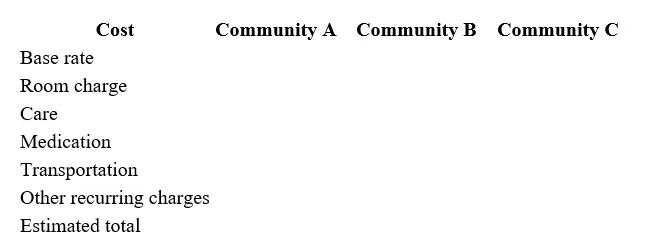
Important: Ask for pricing in writing before making a final decision. A verbal estimate given during a tour may not include every charge that could affect the resident's actual cost.
A community's policies can have a major effect on the resident's experience. Before choosing an Assisted Living community or Nursing Home, understand how it handles family communication, changes in care needs, complaints, transfers, and other situations that may arise after move-in.
Ask for written information about:
• Visiting hours and visitor policies.
• Pets and personal belongings.
• Transportation.
• Room changes.
• Medication policies.
• Changes in care needs.
• Transfers and hospitalizations.
• Discharge policies.
• Deposits and refunds.
• Complaint procedures.
• Resident and family meetings.
Ask who the family's primary contact will be and how communication works.
Useful questions include:
• Who should the family contact with questions?
• How quickly are calls or messages normally returned?
• How are families notified about significant changes in a resident's condition?
• Can family members participate in care planning?
• Are care conferences available?
• How can concerns be formally raised?
• Is there a resident or family council?
For Nursing Homes, Medicare identifies participation in care and communication with residents and families as important aspects of resident rights.
For California Assisted Living communities, the Department of Social Services provides information about resident rights and the state's licensing and complaint processes.
Ask for the admission agreement and other relevant policies before making a final decision.
Pay particular attention to:
• What services are included.
• What services cost extra.
• How fees can change.
• Circumstances that could lead to a transfer or discharge.
• The community's responsibilities if the resident's needs increase.
• Refund and termination provisions.
Important: Do not rely solely on verbal explanations provided during a tour. Important promises and financial terms should appear in writing.
A community's own description is only one source of information. Important claims should be independently verified whenever possible.
For Nursing Homes, Medicare's comparison resources provide information including:
• Overall ratings.
• Health inspections.
• Staffing.
• Quality measures.
Medicare recommends reviewing these types of information when comparing Nursing Homes.
A rating should not be treated as a complete judgment of a Nursing Home. It is one source of information that should be considered alongside the resident's needs, your observations, staff responses, and other information.
In California, Assisted Living communities are generally licensed through the California Department of Social Services' Senior Care Licensing Program. The state's Facility Search provides information about licensed communities and complaint investigation reports.
Check:
• Whether the license is current.
• The type of community licensed.
• Available complaint information.
• Citations or enforcement information, where available.
• Whether the official information is consistent with what the community tells you.
Use independent information to check important claims made during the tour.
For example:
• If a Nursing Home emphasizes its strong quality ratings, review its current Medicare information.
• If an Assisted Living community describes itself as highly experienced in a particular type of care, ask for specific information about the services and staff supporting that claim.
• If a community says it has an excellent inspection record, review the relevant official records.
Tip: Official licensing, inspection, and quality information should complement your visit, not replace it.

No community will be perfect, and one unusual observation does not necessarily indicate a serious problem. Look for patterns and investigate concerns rather than making an immediate judgment.
Pay particular attention to:
• Persistent unpleasant odors.
• Poor cleanliness or maintenance.
• Residents who consistently appear unattended.
• Disrespectful staff-resident interactions.
• Staff unable or unwilling to answer basic questions.
• Unclear or inconsistent pricing.
• Pressure to sign immediately.
• Reluctance to provide written information.
• Significant differences between what was promised and what you observe.
• Difficulty obtaining licensing, inspection, or complaint information.
• Staff who appear consistently overwhelmed.
A red flag should usually lead to a follow-up question or independent verification.
Look for:
• Respectful interactions between residents and staff.
• Staff who know residents by name.
• Residents who appear comfortable and appropriately engaged.
• Clean, well-maintained surroundings.
• Clear pricing.
• Direct answers to questions.
• Families being welcomed.
• Residents participating in activities.
• A clear explanation of how changing care needs are handled.
• Willingness to provide written information.
Important: Positive signs do not guarantee that a community is right for the resident, just as a single red flag does not necessarily mean a community should be rejected. Consider the complete picture.
After several visits, it can be difficult to remember which community had the most suitable room, the most responsive staff, the clearest pricing, or the best daily environment.
A structured comparison can make the decision more objective.
For each community, compare:
• Location.
• Environment.
• Rooms.
• Accessibility and safety.
• Common areas.
• Food.
• Staffing.
• Care.
• Medical services.
• Therapy.
• Activities.
• Specialized needs.
• Pricing.
• Policies and family communication.
• Licensing and quality information.
Avoid allowing one attractive feature to outweigh more important differences in care, staffing, suitability, or cost.
The Map of Care Assisted Living Tool and Nursing Homes Tool are General Tools designed to provide an overall evaluation of the corresponding type of community. They are intended to be used after visiting or virtually touring the communities being considered, after which the results can be compared.
The digital tools provide an overall rating which can be saved on the user’s dashboard. Registered users can also access downloadable evaluation checklists after signing up for free.
The tools can also be useful to community owners and operators. The same structured evaluation can help identify areas where a community may be able to improve its environment, services, resident experience, or other aspects of operations.
A numerical rating is a decision-support tool, not an automatic recommendation.
For example, a community with a higher overall score may be considerably farther from family, while a slightly lower-scoring community may better match the resident's priorities.
Use the evaluation to identify:
• Strengths.
• Weaknesses.
• Areas requiring additional research.
• Differences that matter most to the resident.
Tip: After comparing the communities, identify your strongest candidates and consider making a second visit before deciding.

The final decision should bring together everything you have learned rather than relying on a single factor.
Ask:
• Does the community meet the resident's essential care needs?
• Is the location practical for family?
• Is the living environment comfortable?
• Do staff appear capable and respectful?
• Is the food appropriate?
• Are activities compatible with the resident's interests?
• Can the community accommodate changing needs?
• Is the total cost understandable and affordable?
• Are the licensing and quality records acceptable?
• Does the community seem like a place where the resident could be comfortable and engaged?
Before signing an agreement:
• Review the final pricing in writing.
• Confirm which services are included.
• Confirm the payment arrangements.
• Read the admission agreement carefully.
• Verify licensing or Medicare information.
• Resolve outstanding questions.
• Confirm what happens if the resident's needs change.
A second visit can reveal things that were not apparent during the first tour. Consider visiting at a different time of day or observing a meal or activity.
The decision should prioritize the person's needs, preferences, dignity, safety, and quality of life. Family input is important, but the preferences of the person who will live in the community should remain central whenever they are able to participate in the decision.
Final tip: Don't choose solely because a community has availability today. A careful comparison can help avoid a difficult move later.
Evaluating an Assisted Living community or Nursing Home is much more than taking a tour and deciding whether you like the building. A thorough evaluation considers the resident's entire experience—from location and rooms to staff, care, food, activities, safety, pricing, policies, and the community's ability to respond as needs change.
The most useful approach is to observe, ask, and verify.
Observe how residents and staff interact and what ordinary daily life looks like. Ask specific questions about care, staffing, services, costs, and policies. Verify important information through licensing records, Medicare resources, written agreements, and other reliable sources.
Visiting several communities and evaluating them using consistent criteria makes comparison easier. The Map of Care Assisted Living and Nursing Homes tools can provide a structured way to organize those observations, assign an overall evaluation, and compare communities. Specialized tools can then be added when dementia, accessibility, technology, healthy living, or cost is particularly important.
Ultimately, the objective is not simply to find the community with the most attractive building or the highest rating. It is to find the community that best matches the needs, preferences, finances, and quality-of-life priorities of the person who will live there.
Pay attention to the environment, resident-staff interactions, rooms, bathrooms, common areas, food, activities, staffing, available care, safety, pricing, and the community's ability to meet changing needs.
In addition to the general environment, focus on nursing care, staffing, rehabilitation, medical services, care planning, medication management, emergency procedures, and the Nursing Home's Medicare information.
There is no fixed number. Visiting several suitable communities makes it easier to compare care, atmosphere, services, and cost.
A second visit can be valuable. Consider visiting at a different time of day or during a meal or activity.
Potential concerns include persistent unpleasant odors, poor maintenance, residents appearing consistently unattended, disrespectful interactions, unclear pricing, pressure to make an immediate decision, reluctance to provide information, and discrepancies between what you were told and what you observe.
Ask about staffing levels on different shifts, licensed nurse availability, staff training, turnover, agency staff, and how staffing changes as resident needs change.
Ask for the complete written pricing structure, including the base rate, care charges, room charges, medication, transportation, therapy, one-time fees, and other potential charges.
Medicare's Nursing Home comparison resources provide information including ratings, health inspections, staffing, and quality measures.
The California Department of Social Services provides a Facility Search with information about licensed communities and complaint investigations.
Yes. A virtual tour can provide useful information when an in-person visit is difficult or impossible. Map of Care's evaluation methodology supports evaluation after either a physical visit or a virtual tour.
The Assisted Living and Nursing Homes tools are General Tools that provide an overall evaluation. You first visit or virtually tour the community, then use the appropriate tool to evaluate it and compare the results with other communities.
No. The framework in this guide can be used independently. The tools provide a structured way to record observations and compare communities.
Yes. Map of Care also offers Specialized Tools for areas including Design for Dementia, Tech, Accessibility, Healthy Living, and Cost. These can supplement the general evaluation when a particular issue is especially important.
Yes. The evaluation framework can also help community owners and operators identify areas where they may be able to improve. Map of Care provides a separate provider pathway.
More guides on senior living.